Top-Grain vs Split Leather: What Every Buyer Should Know
Two hides can arrive at a factory both legally labeled "genuine leather" — yet one costs roughly twice as much as the other. That price gap determines whether your shoes develop a rich patina after a year of wear, or start peeling at flex points within months. Here is how to tell the two apart in thirty seconds, and how to specify leather grade within your order to avoid unwelcome surprises.
1. What "Genuine Leather" Actually Covers
"Genuine leather" is an umbrella term, not a grade. Cowhides are thick, so factories split them horizontally into multiple layers. The top layer carries the hide's natural grain: left fully untouched, it is sold as full-grain; lightly buffed to remove surface blemishes, it becomes top-grain. The lower layer left behind becomes split leather. Both are real hide, so both can be sold as genuine leather. The label is not lying to you; it is just not telling you the part that matters.
2. Top-Grain: The Tight, Natural Surface Layer
The grain side of a hide is where the fibers are densest. That density gives top-grain leather the properties buyers actually pay for: it flexes thousands of times without damage, breathes, and absorbs leather conditioners. Rather than simply wearing out, it develops patina — the deepened glow you see on a well-worn high-quality boot. The natural grain is also slightly irregular, which gives it a rich look unlike artificially printed textures.
3. Split Leather: The Lower Layer in a Coating
Split leather has no natural grain surface of its own — its fibers are long, loose and fuzzy. For footwear that mimics a natural grain look, factories apply a heavy polyurethane coating and emboss an artificial grain pattern on top. (Split leather may also be finished as suede.) Fresh out of the box, it can look convincing. The weakness shows at the flex points: the coating is a film sitting on loose fibers, so it creases, turns pale and eventually cracks and peels. No amount of leather care products can reverse this failure, as the visible cracking and peeling occur within the surface coating rather than the hide substrate itself.
4. The 30-Second Fold Test (and Two More Checks)
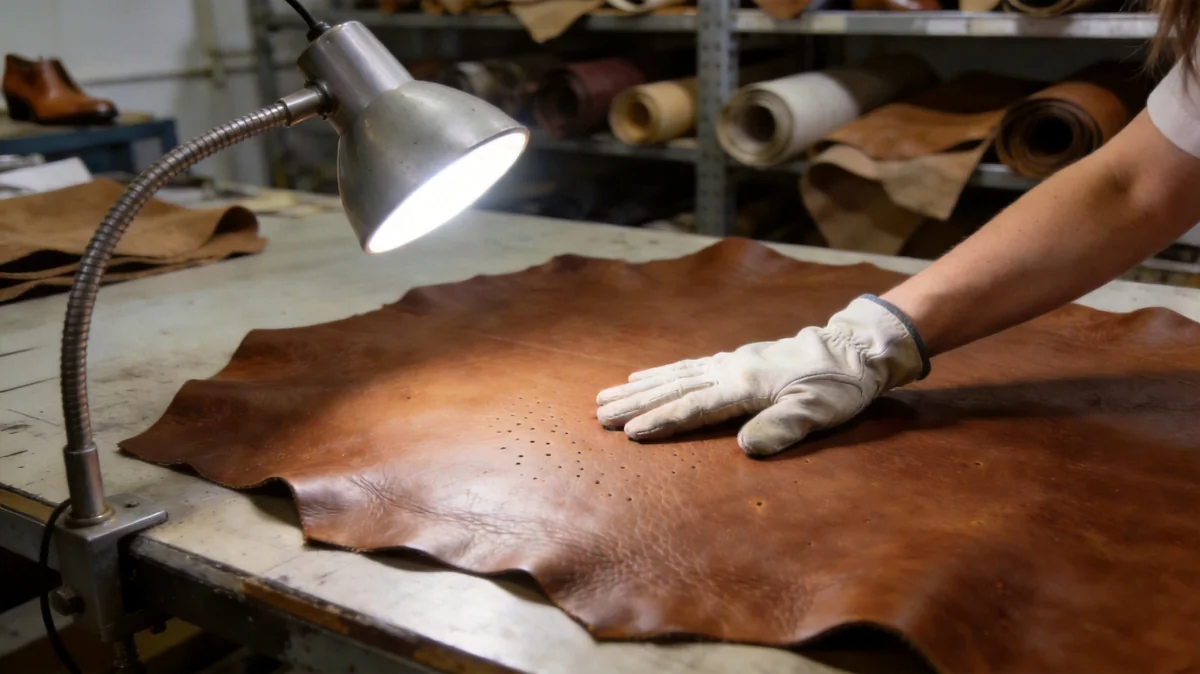
You do not need a lab. When your sample arrives (ours included), run these quick checks:
- The fold test. Fold the leather sharply, grain side out. Top-grain forms a soft, fine crease that relaxes when you let go. Split leather's coating turns pale along the fold line, and with repeated folding it cracks.
- The edge check. Look at a cut edge. Top-grain shows a dense, tight cross-section that thins toward the flesh side. Split leather shows long, loose fibers all the way through, with a visible film on top.
- The pattern check. Real grain is irregular — pores vary, wrinkles differ. An embossed coating repeats the same texture perfectly, like wallpaper. An overly uniform surface is a warning sign.
We perform these exact checks during material intake at our own workshop — the first inspection stage every pair goes through before shipping.
5. Side by Side
| Top-grain | Split | |
|---|---|---|
| Surface | Natural grain, slightly irregular | PU coating with embossed grain |
| Fibers | Tight and dense | Loose and fuzzy |
| Fold test | Soft crease, relaxes back | Coating pales, then cracks |
| After a year | Develops patina | Coating peels at flex points |
| Breathability | Good | Poor — the film seals the hide |
| Material cost | Baseline for quality footwear | Roughly half |
6. Does Split Leather Have a Place?
Yes — honestly, it does. For budget product lines, promotional merchandise and price-sensitive markets, split leather keeps genuine-hide material costs low. The problem is not split leather itself; it is split leather sold at a top-grain price, or quietly substituted after you approved a top-grain sample. That is why the answer is not to ban split leather from your supply chain, but to make sure you always know which one you are paying for.
7. What to Write Into Your Spec Sheet
Three habits protect you on every order:
- Name the grade in writing. "Genuine leather" is not a specification. Write "top-grain cowhide" (or split, if that is what you chose) into the quotation and the proforma invoice.
- Fold-test your sample. It takes thirty seconds and costs nothing. Our sample approval checklist covers the full twenty-minute routine.
- Spot-check bulk goods at the edge. Any cut opening — a strap end, an unlined tongue — shows the cross-section. Compare it against the approved sample.
At Pandasoles, top-grain leather is our standard for leather styles, and the exact material grade is confirmed in writing with your quotation before sampling. For price-sensitive lines, we also offer PU customization — clearly labeled as PU, never sold as leather. You can browse the 77 styles across 13 categories in our catalog, or check the commercial basics on our FAQ page before you write.
Check the Leather Yourself
In-stock styles ship as free samples — fold-test one at your desk. You only cover the courier.
Ask About Samples Send an Inquiry