TL;DR — You do not need to fly to China to verify a shoe factory. Five questions do most of the work: show me your production line on a live video call, how fast can you sample, who inspects the pairs and what happens to failures, can you produce third-party test reports, and what happens if my goods fail on arrival. Judge the answers by their detail density — real factories answer in numbers and method names; middlemen answer in adjectives.
Every buyer sourcing footwear from China faces the same asymmetry: the factory knows exactly what it is, and you know only what its website says. A factory visit closes that gap, but flights are expensive and slow — and for a first order, usually unnecessary. These five questions, asked over email or a call, will tell you most of what a two-day audit would. We answer versions of them every week, so we know what good answers sound like from the inside.
1. "Can I See Your Production Line Right Now — on a Video Call?"
This is the single most efficient verification question, because it is hard to fake in real time. A real factory can usually arrange a live video walk within a day or two: cutting tables, stitching lines, the molding press, workers mid-shift, lasts on the rack. What you are watching for is not polish — it is continuity. The same floor, the same machines, the same people you saw in their photos, with today's work in progress on the tables.
The revealing answers are the postponements. "Let us arrange a visit for you next week" sometimes means exactly what it says — but when it comes with no offer of a near-term video call, it can also mean someone needs to borrow a floor for your benefit. A middleman renting a factory for an afternoon can show you a beautiful line; what they cannot easily do is show it to you tomorrow, unrehearsed, with your name held up on a piece of paper.
One nuance, because it confuses many first-time buyers: a genuine factory that exports through its own trading entity is normal in this industry — the export license and the production line simply sit in two related companies. What matters is not the name on the business license; it is whether the production line itself is real, running, and viewable on demand.
2. "How Long Does Sampling Take, and What Does It Cost?"
Sampling is the first real promise a factory makes to you, and it is a remarkably honest preview of everything that follows. A factory that controls its own line can give you a straight answer: existing styles ship as samples almost immediately, and new developments go through pattern-making and a first sample in a matter of days — our own reference is 7–12 days for a new development, with existing-stock samples free of charge and re-development samples quoted per style. (The full logic of sample pricing is in our sample cost and timeline guide.)
The answers to worry about are the vague ones. If a supplier cannot tell you within a week when your sample will be ready, they are probably waiting on someone else's schedule — which is what your bulk order will be doing too. Also note what they ask you before quoting a sample: a factory that asks about your size run, target market and preferred materials before pricing is planning to make your shoe; one that quotes instantly without questions is planning to find someone who can.
3. "Who Inspects the Shoes, and What Happens to the Failures?"
Every factory claims quality control. The question that separates them is what happens to the pairs that fail. Ask it directly: are shoes inspected pair-by-pair or by sampling, at which stages, and where do rejected pairs go — reworked and re-inspected, or quietly folded back into the bulk?
A factory with a real QC system answers in stages and numbers: incoming material check, in-process check at stitching and molding, pre-shipment inspection, with a measurable defect standard at each gate. (Our own line runs a pair-by-pair final inspection with a 0.3% full-pair defect threshold before packing — we wrote up the whole inspection flow so buyers know what to benchmark against.) A factory without one answers with adjectives: "strict," "professional," "many years of experience." Adjectives are free; a rework loop is expensive, which is exactly why its existence is informative.
4. "Can You Send a Third-Party Test Report for My Materials?"
This question does two jobs at once. Practically, it tells you whether your EU-bound order can survive a market surveillance check — the substances that matter for footwear, chromium VI, azo dyes, phthalates and the like, are invisible to the eye. Strategically, it tests whether the factory's paperwork reflexes are real. A factory that regularly arranges third-party testing will respond with scope and timeline — which substances, which laboratory, how many days. One that does not will respond with a logo.
When the report arrives, spend five minutes on it before you file it: check the laboratory's accreditation number, the test method codes, and whether the sample description matches your actual material and batch. Our buyer's guide to REACH testing walks through exactly how to read one. A report about somebody else's material from three years ago is decoration, not evidence.
5. "What Happens If My Goods Fail Inspection at Arrival?"
Nobody likes asking this question, which is precisely why it works. Every supplier is friendly before the deposit; this question tells you what they are like after it. A factory confident in its output will discuss remedies plainly — remake, replacement in your next shipment, or credit against the balance, defined in writing with a threshold that triggers them. The specifics matter less than the willingness to specify them.
Listen for the difference between "we guarantee the quality" and "here is what we do when something goes wrong." The first sentence is a mood; the second is a system. Factories that have actually handled claims answer this fast, because they already know their own policy. Ones that have never thought about it will improvise — and improvisation after a problem is what you are trying to avoid.
6. Reading the Answers: Detail Density Is the Tell
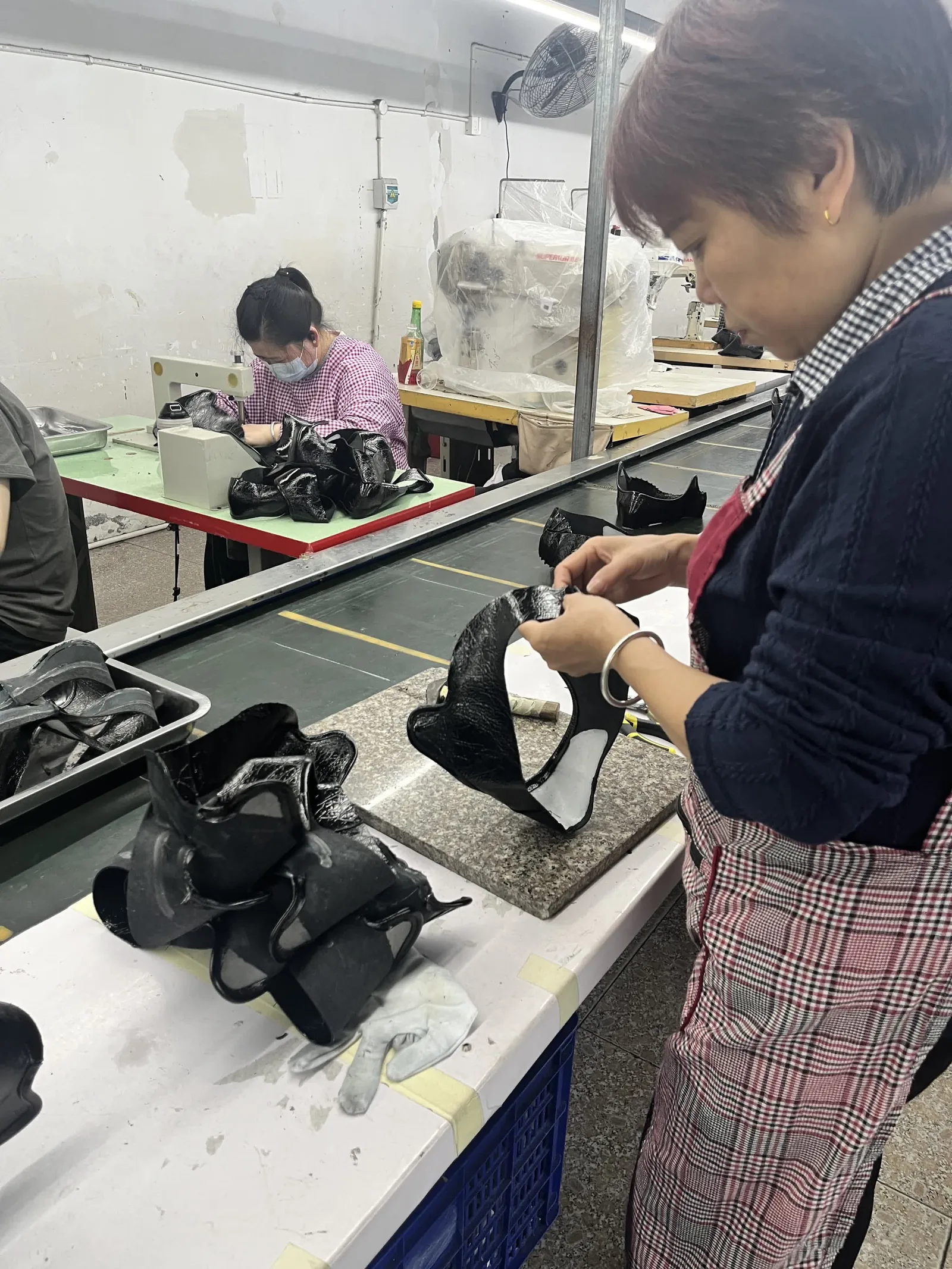
Across all five questions, one principle ties everything together: judge answers by their detail density, not their confidence. A real factory says "7–12 days," "SATRA TM92," "0.3%," "our stitching supervisor rejects at the machine" — because these numbers are how they actually run the floor. A middleman says "fast," "high quality," "strict inspection" — because adjectives are all they have access to.
And watch who asks questions back. A factory that interrogates your size run, your market, your packaging and your target price before quoting is a factory planning your production. One that agrees to everything immediately is planning to agree to everything — right up until the container doors open.
At a Glance
- Ask for a live video walk of the line on short notice — real factories can show you tomorrow, unrehearsed
- Sampling speed and pricing is the first real promise — vague timelines now mean vague timelines at bulk
- Ask where failed pairs go — a rework loop is the difference between a QC system and a QC slogan
- Request a third-party test report on your actual materials — and read the accreditation, methods and sample description
- Define the failure remedy before the deposit — willingness to write it down matters more than the terms
- Judge detail density: numbers and method names beat adjectives, every time
Questions Buyers Ask
"Do I need to fly to China to audit a factory?"
Usually not for a first order. A live video walk of the production line, recent third-party test reports and a small trial order cover most of the risk. Save the flight for when the relationship is scaling — by then you will know exactly what to look at.
"Will a factory take my small order seriously?"
Watch how they handle the small things: sampling speed, how precisely they answer MOQ questions, whether the person you talk to can make production decisions. A factory that treats a 200-pair trial order carefully is telling you how it will treat a 5,000-pair repeat.
"How do I tell a real factory from a trading company pretending to be one?"
Ask for a live video walk of the production line on short notice. A real factory walks you to the cutting table within days; a middleman needs a week to arrange a borrowed floor. Note that the reverse case is normal and fine: many genuine factories export through their own trading entity — what matters is that the production line itself is real and viewable.
Want to Verify Us First?
Ask us any of these five questions — or book a live video walk of our production line this week. We will bring the camera to the cutting table.
Get a Wholesale Quote Send an Inquiry