
TL;DR — Riding boots live or die on three things: shaft fit graded across the size run, leather thick enough to stand without slouching, and sole construction that survives real wear. Get those right and returns drop to almost nothing.
Knee-high riding-style boots are a category where customers forgive nothing. A boot that slouches, pinches the calf, or creases badly at the ankle comes back — and boot returns are expensive. After producing riding-style boots across multiple seasons, we can tell you the quality conversation has only three real topics. Here is what to check, in order.
1. Shaft Fit: The Number That Decides Returns
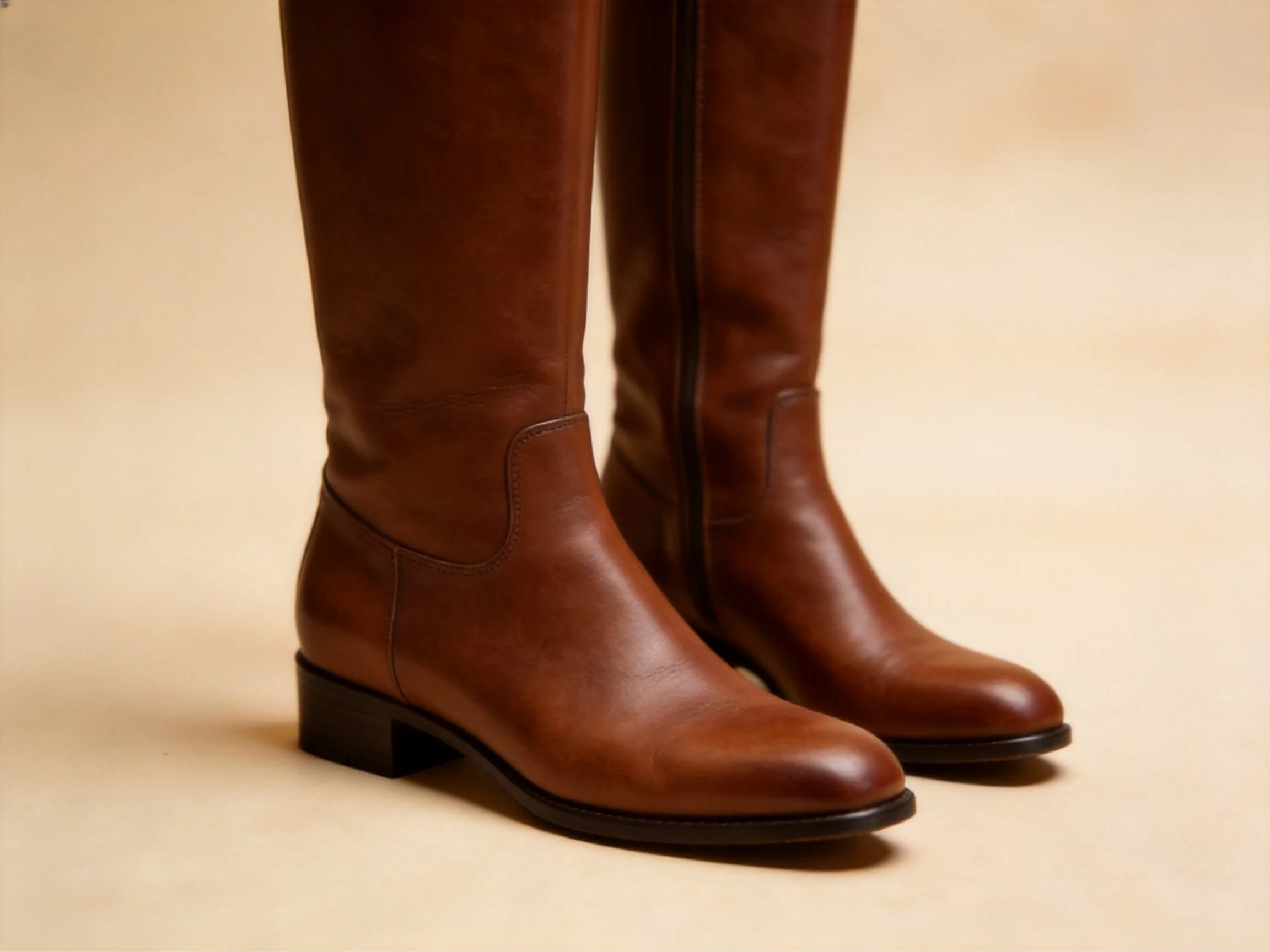
The shaft circumference is the single most complained-about dimension in tall boots. Too narrow and customers cannot zip them; too wide and the boot looks like a bucket. Two rules we work by:
- Grade the shaft with the foot size — a EU36 and a EU41 customer do not have the same calf; the shaft must grow through the size run, not stay fixed
- Offer a wide-calf option — typically +2 to +3 cm at the top circumference; for many markets this single option removes the biggest return reason
Also check the back seam: a well-made riding boot has a shaped back seam that follows the calf curve. Straight-tube shafts are cheaper to cut and always look it.
2. Leather: Thick Enough to Stand, Soft Enough to Walk
A riding boot shaft should stand upright on the shelf with no support. That requires 1.6–2.0 mm cowhide in the shaft — anything thinner slouches within weeks. But the same boot needs softness where the ankle flexes, or every step creases and eventually cracks the leather at the flex line. The answer is selective thickness: firm hide for the shaft, a softer grade (or a thinned skive) through the ankle zone. When you receive a sample, do two things: stand the boot on a table and see if the shaft holds, then flex the ankle twenty times and look at the crease pattern. Sharp white creases mean the leather or the skiving is wrong.
3. Construction: The Sole Takes the Real Abuse
Riding-style boots are worn hard — pavement, stirrups, weather. The sole attachment is where cheap versions die:
- Cemented rubber soles are standard and fine — if the edge finish is clean and the flex point is reinforced; twist the boot and listen for any creak of separating layers
- The heel stack should be real stacked leather or a dense ABS equivalent; hollow heels drum and crack
- The zipper is a construction component, not a trim: specify branded zippers (YKK or equivalent), and check that the zip runs past the ankle flex zone without buckling
- Lining — full sheepskin or textile lining through the shaft; unlined shafts in thin leather collapse and rub
Sourcing Notes for Buyers
Boots use roughly double the leather of a pump, so material grade drives the unit price more than in any other category — this is where a clear leather specification pays for itself. On existing patterns, our MOQ is 100–200 pairs per style with custom shaft dimensions available, which makes a two-height, two-calf-width range realistic even for a first boot order. Sampling takes 7–12 days; plan boot samples early, because fitting a tall shaft takes one or two more fitting rounds than a pump.
Sourcing Boots for Next Season?
Send your reference boot or target measurements — we will confirm the pattern path and quote sampling in 7–12 days.
Get a Wholesale Quote Send an Inquiry